During winter storms across Tigard, relying on your Tesla for vehicle-to-home (V2H) backup power requires precise digital and physical synchronization between the vehicle charger and home inverter. Small communication delays or moisture-induced ground faults in outdoor enclosures will instantly abort the bidirectional handshake, leaving your household unprotected during grid failures.
Understanding the Bidirectional Handshake Protocol
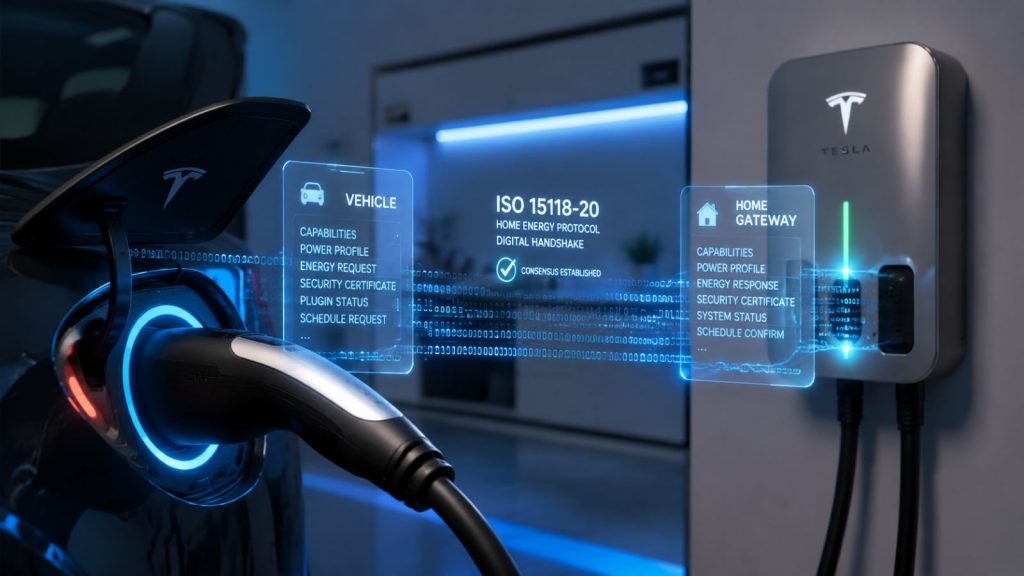
Reversing energy flow to run a domestic panel from an electric vehicle requires a complex digital consensus. The system uses the ISO 15118-20 protocol to handshake via the control pilot circuit. It’s a tight, encrypted exchange—if the timing is off by even a few milliseconds, the whole inversion cycle kills the power to protect the onboard electronics.
When a Tesla connects to a home gateway, the vehicle communication controller initiates an encrypted Transport Layer Security handshake with the supply equipment. This digital exchange assigns localized IP version 6 addresses before any physical contactors click shut. The vehicle and the home system must agree on voltage baselines, current limitations, and thermal margins within milliseconds.
Factory manuals suggest this negotiation is seamless, but workbench testing proves otherwise. I frequently isolate firmware discrepancies where the home automation layer expects an immediate XML interchange, but the vehicle onboard charger delays the response. This timing gap creates an immediate loop failure, aborting the inversion cycle to protect internal power electronics.
| Operational Parameter | Standard Charging | Bidirectional V2H Integration |
| Power Direction | Grid to vehicle | Two-way flow |
| Communication Layer | Basic signaling | Encrypted ISO 15118 stack |
| Primary Safety Focus | Overcurrent prevention | Isolation and anti-islanding |
Standard charging demands a steady feed of AC power, but bidirectional integration forces the vehicle to act as the primary generation plant. The system triggers a fail-safe mode if the initial communication stack does not clear, which unfortunately prevents the vehicle from energizing your home panel during a blackout.
Identifying Signal Latency in your Home Power Loop
Monitoring packet exchange requires deep diagnostic intervention. I connect a high-speed digital oscilloscope directly to the control pilot conductor to read the pulse-width modulation waveform. A clean connection displays a sharp, one-kilohertz square wave.
When latency infiltrates the loop, the leading edges of the waveform distort into sloped curves. This geometric breakdown indicates high capacitive coupling or digital jitter within the home gateway. Because this is invisible to consumer apps, I trace the delay to either an unpatched firmware module or physical degradation in the onboard digital transceiver.
Why Tigard Humidity Threatens Your Electrical Junction Boxes
The Pacific Northwest climate imposes constant stress on high-voltage infrastructure. In the Tigard region, persistent moisture infiltrates any enclosure lacking absolute sealing. Outdoor-rated type 3R junction boxes protect against rain, but they remain vulnerable to dense evening humidity. As temperatures fluctuate, water vapor condenses on terminal blocks and the conductive copper pads of the inverter system.
Moisture intrusion alters the baseline dielectric properties of the air inside the enclosure, creating a low-resistance path to ground.
This moisture forms a microscopic film that bridges circuits, lowering the isolation resistance of the home infrastructure. This is critical during Portland General Electric grid shifting when sudden voltage drops force the home to draw power from the car. When the Tesla gateway performs its insulation test, it reads this parasitic pathway as a ground fault risk. The National Electrical Code demands strict isolation limits; the system will lockout immediately if a breach is detected.
Detecting Moisture-induced Resistance in Outdoor Connections
Unchecked condensation triggers chemical oxidation across exposed terminals. Aluminum and copper interfaces develop a non-conductive oxide crust, introducing resistance into the power loop. During high-current discharge, even a fraction of an ohm of resistance generates extreme thermal energy.
- Oxidation blocks flow, forcing the inverter to increase voltage output to compensate.
- Increased voltage drops cross-corrode adjacent signaling pathways.
- Thermal expansion compromises mechanical terminal torque specifications.
I use thermal imaging cameras to inspect enclosures and heat sinks under stress. A compromised terminal block glows on the infrared spectrum long before it creates an arc fault. Cleaning these connections and applying hydrophobic compounds prevents the degradation that disrupts home energy storage during winter storms.
Advanced Diagnostic Procedures for Bidirectional Power
Verifying a vehicle for home power generation is separate from standard maintenance. Operations start at the lift with a full diagnostic sweep of the onboard power electronics and critical thermal management loops. If the car cannot stabilize its internal output, it cannot safely supply a residential structure.
Once the vehicle clears validation, I analyze the home interface using bench simulators that replicate the local electrical footprint. In the testing bay, a performing bidirectional ecosystem has a distinct signature. Monitoring the diagnostic screen while checking for heat-stressed cables and listening to the transformer’s steady acoustic hum.
Testing Inverter Waveform Stability Under Full Load
The ultimate test is behavioral response under heavy electrical load. I apply a simulated domestic load to the inverter while monitoring real-time AC output on a multi-channel analyzer. A healthy backup infrastructure produces a pure sine wave with minimal harmonic distortion.
During a recent assessment, the monitor tracked a rise in total harmonic distortion to 7.5% as the system attempted to pick up the household load. This exceeded safe parameters, causing the communication link to drop. While the factory manual suggested replacing the control module, my analysis pinned the failure on a degraded line filter capacitor. Replacing that single component restored stability, proving that micro-level diagnostics prevent costly, unnecessary part swaps.
Ensure your home backup infrastructure is ready for the next grid event. Contact Tigard SUV and Auto at 12394 SW Scholls Ferry Rd, Tigard, OR for a professional pre-flight diagnostic of your Tesla bidirectional system.
Frequently Asked Questions
Is my home inverter compatible with Tesla V2H?
No, standard solar inverters lack the internal bidirectional switching architecture and communication stacks required to interface with a Tesla system. Safe vehicle-to-home operation requires a specialized gateway and an inverter certified for bidirectional grid-tied isolation and load management.
Does high humidity negatively impact my charging setup in Tigard?
Yes, persistent moisture creates condensation layers inside exterior electrical enclosures. Moisture compromises insulation resistance, which trips ground-fault lockouts and prevents the vehicle from completing its power handshake.
Can a firmware mismatch prevent my backup system from functioning?
Yes, discrepancies between the vehicle software and the home gateway communication firmware disrupt the precise packet timing needed for bidirectional power transfer. These digital errors cause safety system aborts even when physical wiring and infrastructure components remain fully functional.
Does total harmonic distortion matter for the health of my backup power?
Yes, high harmonic distortion degrades the quality of AC power supplied to your home. Exceeding 5% distortion forces a safety shutdown, protecting household appliances from the heat and stress of poor power quality.
Will an inspection at your facility identify hidden system issues?
Yes, the inspection includes a forensic sweep of the vehicle onboard charger matched against simulated home energy profiles. This process utilizes isolation resistance testing, oscilloscope inspection of communication waveforms, and thermal imaging to locate hidden electrical deficiencies.