Maintaining Tesla safety requires professional ADAS recalibration after glass replacement, as minor variances compromise Autopilot. We utilize OEM glass and mandatory dynamic calibration to ensure your onboard computer seamlessly reconciles new hardware. This process restores the high-precision environmental mapping and overall performance necessary for your vehicle’s safety.
Why Windshield Replacement Affects Tesla Autopilot Features
When a windshield is replaced, the physical placement of the camera bracket becomes the most critical variable. While a one-degree angular deviation may appear insignificant, it represents a critical failure in computer vision systems. At highway speeds, that single degree causes the camera to miscalculate the distance to the vehicle ahead or the position of lane markers by several feet. The vehicle’s computer, expecting the image to align with its previously learned projection, suddenly receives distorted spatial data. This disconnect is why post-replacement calibration is not just a suggestion, but a requirement for the system to function correctly.
The Importance of OEM Glass For Tesla Sensor Accuracy
Aftermarket glass rarely survives a close inspection under the Tesla camera system. OEM glass is not just a window, as it acts as a critical component of the vehicle’s sensor suite. It incorporates specific acoustic layers, precise thickness, and, most importantly, bracket tolerances that are measured in microns. Aftermarket glass often introduces subtle refraction or slight curvature shifts that the Tesla software cannot compensate for during operation. When the glass does not perfectly match the factory optical signature, the camera struggles to resolve lane markings, and the vehicle may trigger persistent warnings that never resolve, regardless of how long the vehicle is driven.
Understanding The Tesla Dynamic Calibration Drive Process
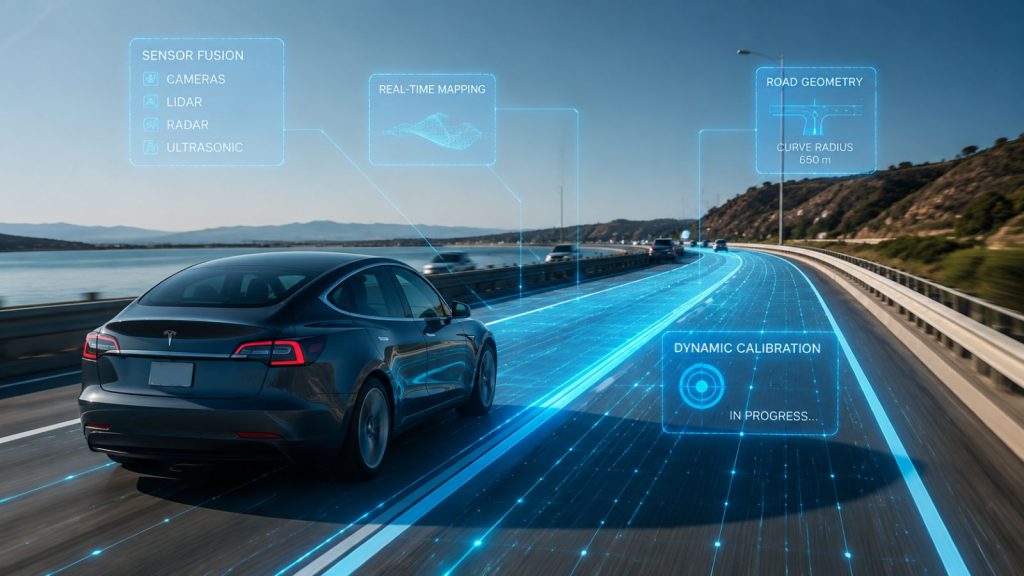
Unlike traditional vehicles where a technician might point a laser at a static target board to align a camera, Tesla employs a dynamic, machine-learning-based approach. The car must be driven in the real world to complete the handshake between the hardware and the software. It uses its own vision to triangulate its position relative to the road markings and objects it recognizes. During this drive, your vehicle acts like it is learning the road again, gathering thousands of data points to build an accurate map. It constantly checks its vision against what it expects to see, automatically adjusting until the software matches the physical world perfectly.
Best Driving Conditions for Tesla Calibration in Tigard
The success of the calibration drive depends heavily on the environment. Trying to calibrate on a winding, poorly marked road is a recipe for frustration and failed data collection. For vehicles in Tigard, a deliberate drive on well-marked highway sections with consistent traffic flow yields the best results. If the driving cycle consists only of stop-and-go traffic, the camera does not obtain the high-speed lateral motion data it needs to calculate lane geometry correctly. Optimal calibration requires multi-lane highways featuring high-contrast lane markings and minimal interference, enabling the vehicle to accurately verify its spatial position across multiple lanes.
Technical Realities of Professional Windshield Installation
Factory calibration averages 25 miles, but humidity and curing variances can delay the process. We minimize this risk through precise, uniform urethane application. By ensuring the camera bracket seats perfectly as it cures, we prevent the alignment shifts that often trigger secondary ‘Calibration Required’ alerts.
Why ADAS Systems Fail
When a Tesla throws a “Calibration Required” error that won’t clear, it’s rarely a software glitch—it’s a mechanical failure. In my shop, I look for these three smoking guns:
- Urethane Creep: If the glass isn’t shimmed during the 24-hour cure, it can settle by as little as 0.5mm. That microscopic shift is enough to throw off the camera’s spatial mapping, causing persistent lane-drift warnings.
- Bracket Stress: If the mounting hardware isn’t torqued to OEM specs, the assembly vibrates at highway speeds. This creates visual noise, leading to unpredictable phantom braking.
- Optical Distortion: Aftermarket glass often lacks the precision thickness of OEM panels. Even a minor refractive mismatch creates ghost images that the Tesla’s computer vision struggles to reconcile.
Verifying Successful ADAS Calibration Results
The smoking gun is the moment of clarity on the dashboard when the progress indicator hits one hundred percent. Erratic steering inputs and phantom braking incidents cease because the camera is finally seeing the lane lines where they actually exist. Verifying this cycle restores your vehicle’s vision to factory-certified standards, ensuring total accuracy for safe, autonomous operation.
Maintaining Long-Term Tesla Safety System Reliability
Calibration is only the first step in ensuring long-term performance. Once the initial dynamic drive is successful, the vehicle continues to monitor its own vision data for consistency. Even long after a successful replacement, issues like heat-induced expansion or worn wiper blades can degrade the camera’s view, causing the system to flag persistent errors.
Regular checks for condensation or debris within the sensor enclosure can prevent the need for repetitive calibration cycles. By treating the glass not as a commodity but as a precision optical instrument, the vehicle’s safety features remain reliable and accurate throughout the life of the windshield.
Ready for precision service? Reach out to the experts at Tigard SUV and Auto to schedule your Tesla windshield replacement and ADAS recalibration. We guarantee that your safety systems are perfectly aligned and road-ready. Visit us at 12394 SW Scholls Ferry Rd, Tigard, OR, to experience professional, manufacturer-standard care.
Frequently Asked Questions
Is ADAS calibration mandatory after a Tesla windshield replacement?
Yes. Tesla service documentation mandates that the forward-facing camera system must be recalibrated following any windshield replacement. Even a microscopic shift during the reattachment of the camera housing is enough to impair Autopilot and compromise your vehicle’s essential safety features.
Will my Tesla function correctly if I skip the dynamic calibration drive?
No. Skipping the calibration process results in disabled or degraded ADAS features, such as lane-keeping and automatic emergency braking. This re-learning process is non-negotiable; missing it degrades the vehicle’s spatial precision and substantially increases the danger of lane drift, braking errors, and erratic behavior.
Does the dynamic calibration process function on local roads?
Yes. The dynamic calibration process relies on driving the vehicle on well-marked roads to allow the onboard computer to map its surroundings. Machine learning algorithms reconcile road data with the camera’s position, ensuring the system accurately understands its new geometric baseline.
Is OEM glass strictly required for optimal Tesla camera performance?
Yes. OEM glass is required because Tesla cameras are calibrated to the specific optical properties, thickness, and curvature of factory-specified windshields. Aftermarket glass often lacks the precise acoustic interlayers or bracket mounting tolerances required to ensure the camera lens captures a clear, undistorted image for the vehicle’s computer vision system.