Cruising through summer heatwaves along SW Scholls Ferry Road or getting stuck in traffic on OR-217 forces your Tesla’s thermal management system to run at maximum duty cycles. If internal mechanical resistance builds within the electric coolant pump, the low-voltage motor draws a sustained current spike exceeding 15% for over 300 milliseconds, logging an internal diagnostic fault long before a complete pump seizure can occur.
Why Your Tesla Registers a Thermal Alert on SW Scholls Ferry Road
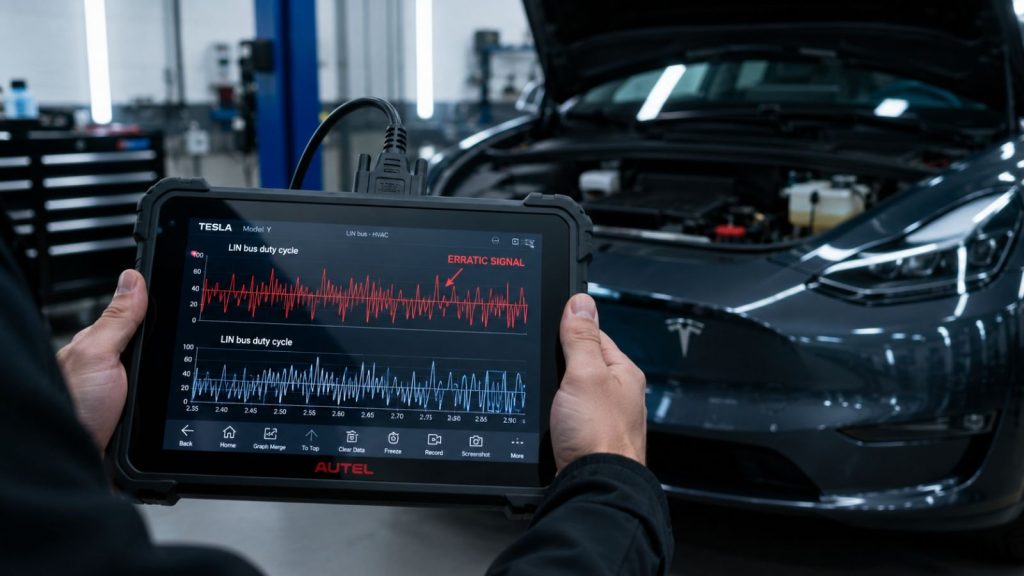
I watch the diagnostic terminal monitor a captive Model Y while its front cooling fans scream at maximum velocity inside the service bay. The vehicle recently coasted off SW Scholls Ferry Road after the central thermal processor spent miles tracking an internal breakdown completely unnoticed by the driver. This high-frequency digital conversation over the LIN bus allows the car to monitor current draws and catch sub-millisecond telemetry deviations before physical components lock up.
Physical resistance forces the pump motor to draw excess current, and any fifteen percent spike lasting past 300 milliseconds triggers an immediate, hidden diagnostic log.
Is it a Failing Coolant Pump or Pacific Northwest Moisture Intrusion
With the vehicle up on our two-post lift, I pull the front aero shield panel to inspect the integrated Octovalve assembly and its cooling lines. This physical diagnosis often reveals a direct conflict with official factory documentation, as over-the-air updates can reset early parameter anomalies and mask real mechanical pump wear. The service manual says swap the pump the second the code hits, but I always look for green crust on the pins first.
The extreme thermal loads of a late Pacific Northwest summer will quickly expose whether we are dealing with genuine internal component failure or a secondary electrical issue.
Pinpointing Wiring Harness High Resistance Near Highway 99W
Before condemning the pump motor, I pull back the locking tabs on the low-voltage electrical harness connector to check for corrosion. Moisture forced past the rubber weather seals during commutes on Highway 99W creates a gritty tracking across the terminal pins. This accumulation introduces destructive electrical resistance directly into the low-voltage circuit. My digital multi-meter flagged a 1.2V drop across the ground terminal—proving the copper connection was corrupted by road brine long before the pump motor itself could fail.
How the Thermal Controller Protects the High Voltage Battery Pack
If that pump binds completely during a fast-charge, you’re looking at localized cell swelling and instant, permanent capacity drop. Lithium-ion cells operate safely within a highly restricted temperature window, meaning any reduction in glycol flow risks severe localized cell damage. The system permits no thermal deviations, as a complete pump seizure during acceleration or fast-charging causes immediate cell swelling and permanent capacity loss.
The predictive cooling software stops this terminal failure by logging electrical load mismatches before fluid velocity drops to zero.
Why Maximum Coolant Pump Duty Cycles Fail During August Heatwaves
An August heatwave in Tigard pushes the entire EV cooling loop to its absolute limit as ambient temperatures climb into the mid-nineties. The vehicle is forced to split its cooling capacity between chilling the cabin and protecting the battery cells from the intense heat generated by stop-and-go driving. Running a pump at its absolute limit when the bearing is already chewed up by internal debris causes the motor windings to overheat and fail. Once the predictive algorithm identifies that current consumption remains high while fluid flow rates drop, it commands a restricted performance mode to safeguard the battery.
Advanced Electric Vehicle Diagnostics
Accurately diagnosing an intermittent thermal management issue requires replicating the exact environmental stresses that triggered the initial fault log. I hook up our dedicated diagnostic interface to monitor live LIN bus duty cycles and prepare the vehicle for a real-world road test. This lets me watch how the electric motor handles changing loads on the fly, instead of just trusting a still reading while the car sits on the garage floor.
Our specialized tooling captures the real-time relationship between commanded duty cycle, actual impeller speed, and low-voltage current consumption.
Reading LIN Bus Duty Cycles During The OR-217 Commute
I steer the car onto the stop-and-go congestion of the OR-217 corridor toward Beaverton to place the thermal loop under maximum stress. As the battery gets heat-soaked in bumper-to-bumper traffic, the live data stream shows a jagged, unstable waveform with sharp, erratic jumps in current. Back in the shop, I confirmed heavy internal impeller drag, so I hand-torque the replacement pump bolts to the exact factory specification of 1.8 Newton-meters.
After pulling a vacuum and refilling the coolant to eliminate any trapped air, the numbers on my scanner leveled out into a smooth, normal baseline.
Don’t wait for a restricted performance mode to catch you off guard on Scholls Ferry Road. Reach out to Tigard SUV and Auto at 12394 SW Scholls Ferry Rd to map your vehicle’s live LIN bus telemetry and safeguard your high-voltage battery pack before the summer heat hits.
Frequently Asked Questions
Will a failing Tesla coolant pump always trigger a bright dashboard warning light immediately?
No. Tesla predictive cooling software catches early mechanical failures before severe overheating occurs. The system logs internal diagnostic codes when it detects a 300-millisecond current spike well before a driver sees a performance restriction or a warning message on the screen.
Can driving through deep standing water cause false cooling system alerts on a Tesla?
Yes. Exposure to heavy road water can breach the weather seals on low-voltage pump connectors. This moisture intrusion causes localized corrosion and high electrical resistance across terminal pins, which alters the electrical current signals and misleads the computer into logging an impending pump failure.
What are the main physical symptoms of a mechanical coolant pump seizure?
Usually, you’ll first notice a loud, high-pitched whine from the front end when the electric motor starts binding, and then the radiator fans will kick on and run flat-out without stopping. Drivers will also notice significantly slower fast-charging rates and message alerts indicating reduced vehicle power.
Is it safe to drive a Tesla if the thermal management system logs a fault?
No. Operating an electric vehicle with a compromised cooling loop during hot weather can lead to localized cell overheating. The central computer will restrict acceleration to protect the high-voltage battery, but continuing to drive risks causing permanent capacity loss or severe battery degradation.