Navigating summer traffic congestion along Highway 217 or past Summerlake City Park continuously logs unencrypted driver metadata directly onto your Tesla’s Media Control Unit flash storage. Without deploying an active physical network isolator during a vehicle service session, unvetted diagnostic tools can automatically scrape your private navigation history, Bluetooth syncs, and rolling dashcam footage.
Why Private Navigation Data Leaks During a Standard EV Repair
Routine local trips along Scholls Ferry Road past Summerlake City Park continuously log unencrypted driver data directly to the flash storage partitions of the media control unit. Without network isolation, this component continuously saves unencrypted location histories, Bluetooth-synced phone contacts, and Wi-Fi handshakes straight to the vehicle. When an automobile enters a service bay, standard repair procedures require pulling performance codes from the central network.
Connecting an unvetted diagnostic terminal without data fencing protocols allows the vehicle’s personal logs to mirror onto the shop server without the owner’s knowledge. The risk is not malicious intent from the mechanic but rather the automated nature of modern diagnostic software which vacuums up complete vehicle logs by default during a standard system scan.
The Myth of Software Barriers and Tesla Valet Mode Limitations
Valet Mode is a simple software restriction designed to limit top speeds and lock physical compartments like the glovebox. It is not an encryption mechanism for the vehicle file system. I see this misconception every week when owners hand over their key cards. Even if Valet Mode hides your home coordinates on the central touchscreen, the underlying Linux kernel architecture stays wide open to any diagnostic tool plugged into the hardware.
If I tap into the central gateway while the car is stuck on basic factory configurations, I can use a standard packet sniffer to pull unencrypted user data right out of the partitions. The software barrier only blocks the user interface, leaving the back-end communication channels completely exposed to anyone with the right diagnostic cable.
How We Fence Off Vehicle Telemetry on Scholls Ferry Road
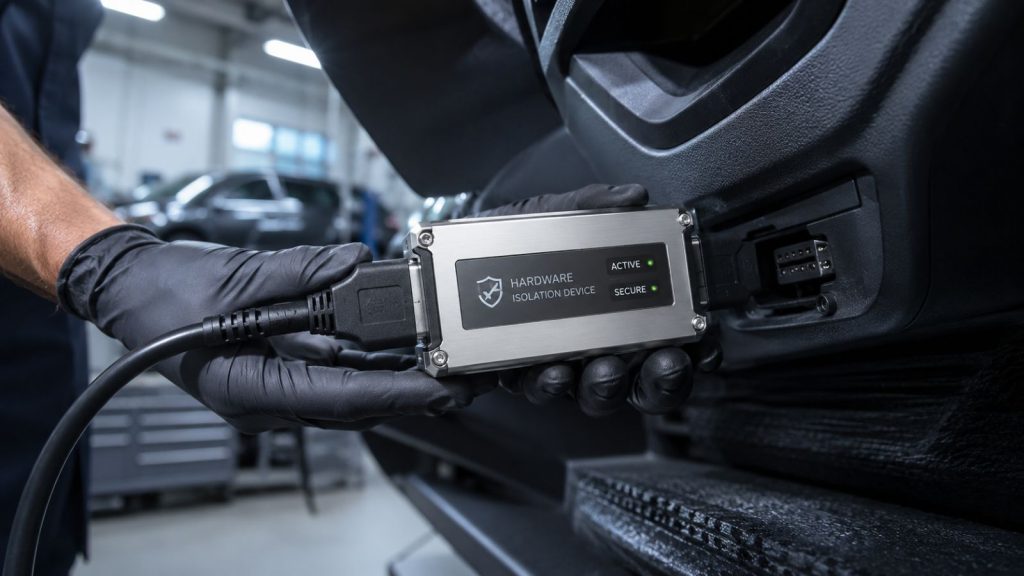
True data protection requires an active approach that completely separates shop equipment from personal user partitions. Before I even boot up the Toolbox diagnostic software loop, I install a dedicated hardware isolator inline with the factory network adapter. This device functions as a physical firewall, permitting the transmission of critical fault codes, battery cell health metrics, and motor calibration values while completely blocking requests for user profile directories.
Isolating the Proprietary Diagnostic Port From External Shop Networks
The factory manual tells us to plug diagnostic terminals straight into the vehicle communication bus, but doing that opens a direct bridge for your private data to spill onto a shop’s server architecture.
Factory service guidelines assume a completely trusted network environment, but real world cybersecurity demands total isolation between the vehicle telemetry bus and external storage storage arrays.
By placing a physical hardware barrier between the car and the diagnostic computer, I ensure that local authentication tokens never leave the vehicle chassis. This process stops automated data collection scripts from harvesting the digital identity of your car while we perform routine mechanical diagnostics. It changes the connection from an open information exchange into a strictly limited read only pipe for hardware alerts.
Protecting Digital Storage Drives From the Highway 217 Traffic Backup
The current summer road construction on Highway 217 near the Greenburg Road exit has turned daily commutes into prolonged idling sessions. While local drivers sit in stop-and-go traffic, their integrated dashcams and Sentry Mode sensors run continuously to save hours of uncompressed high-definition video. Prolonged traffic idling forces the vehicle’s media control unit to continuously write heavy, raw video files directly onto its internal flash storage.
This heavy write cycle raises drive temperatures, especially during hot July afternoons. My bench tests show that a 45-minute idle in 90°F Tigard heat spikes eMMC temperatures enough to cause transient buffer overflows—meaning those unencrypted Sentry clips sit raw in the cache, waiting for the first unisolated scan tool to sync them.
I use specialized packet analysis software to ensure these temporary system buffers do not bleed across the local network during a component test. When the mechanical side of the job wraps up, I double-verify that the transient cache files are completely walled off so that random video snippets of your local commute don’t end up logged in a permanent diagnostic file.
How Network Packet Analysis Guarantees Total Driver Data Privacy
As I monitor the live data stream, the cooling pumps beneath the floorboards click and hum to stabilize battery temperatures during our system scan. The terminal screen confirms that every outbound packet containing location metrics or personal phone logs is actively dropped by our hardware firewall. The final step of the job is putting the car through a full network validation test that simulates a high-load climb up the steep grades of Bull Mountain.
Watching the monitor show a flawless waveform and zero token leakage is the ultimate proof that a shop can handle deep EV diagnostics while keeping the driver’s personal data completely boxed out. To lock down your vehicle’s network data loops behind a physical hardware firewall during your next mechanical service, schedule an isolation diagnostic session with Tigard SUV and Auto at 12394 SW Scholls Ferry Rd, Tigard, OR.
Frequently Asked Questions
Does Tesla Valet Mode protect my personal data during a repair?
No. Valet Mode only hides your screen address and locks the glovebox without encrypting files. Your location history and phone logs remain fully exposed through diagnostic ports unless the shop connects a physical hardware isolator to protect your data.
Can shops block dashcam and Sentry log migration during a scan?
Yes, they can. Honest shops protect your privacy by placing a physical network isolator right at the car’s diagnostic port before running codes. That inline fence stops your personal profile logs and raw dashcam clips from instantly bleeding over to a random shop computer the second the scan tool boots up.
Can unencrypted Bluetooth logs be copied during a vehicle scan?
Yes. Hooking an EV to an unisolated diagnostic tool lets unencrypted cell data, contacts, and call logs copy straight onto the shop’s drive. Dropping a hardware firewall into the loop completely cuts off those personal data pathways while we run our mechanical tests, keeping your private files safe.
Are location, token, and dashcam data exposed during a direct scan?
Yes, multiple data types are vulnerable. The media control unit flash storage retains your last twenty navigation destinations, saved addresses, cellular network tokens, and rolling ten-minute dashcam videos. These unencrypted packets are highly exposed if a shop plugs directly into the vehicle network without using dedicated gateway isolation tools.