Diagnosing BMW TwinPower Turbo oil pressure drops requires ISTA diagnostics and manual gauge testing to detect heat-soaked sludge. To prevent bearing failure, we must inspect pump solenoids, monitor oil consumption in high-mileage engines, and shorten oil change intervals for stop-and-go driving.
Idling in stop-and-go Scholls Ferry traffic spikes engine bay temperatures, regularly triggering low oil pressure faults on N20, N55, and B58 engines. I see firsthand how these high heat spikes push engine oil past safe limits. If ignored, those early dashboard warnings can quickly snowball into catastrophic bearing failure.
How BMW TwinPower Turbo Oil Pressure Mechanics Fail
Modern TwinPower Turbo engines don’t rely on old-school, straightforward oil pumps. Instead, they use map-controlled oil pumps and electronic solenoids to dynamically adjust line pressure based on current engine load. Under normal operation, the engine computer sends precise pulse-width modulation signals to the electronic control valve to maintain exact internal pressure.
The trouble starts with thermal heat-soaking. High-output turbochargers generate massive amounts of heat. When service intervals stretch past safe mileage thresholds, that heat literally cooks your synthetic engine oil.
Over time, this localized baking creates stubborn carbon deposits and sludge that choke tiny internal oil feed passages. When degraded fluid causes the control valve to stick, sensitive internal components are left completely starved of proper hydraulic pressure.
Proactive Diagnostic Process for BMW Oil Problems
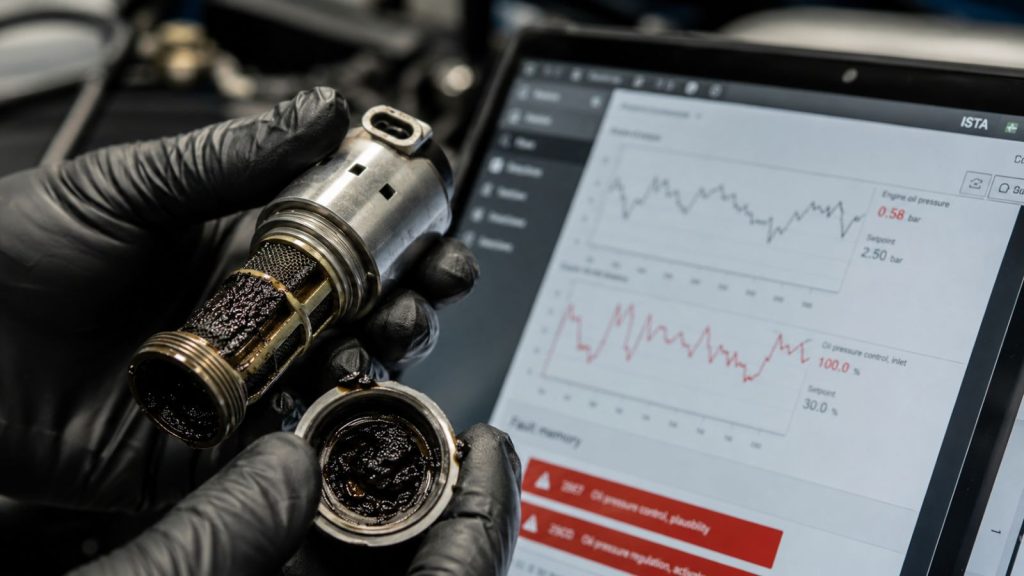
When drivers present oil pressure anomalies, relying solely on a dashboard computer scan won’t cut it. Here is how we track down the root cause in the bay before recommending engine repairs:
- Factory Software Analysis: First, we use ISTA software to compare real-time oil pressure numbers against exact factory targets during both cold and warm idles.
- Manual Pressure Testing: Next, a physical mechanical pressure gauge is threaded straight into the filter housing, providing a true reading of actual pump performance instead of blindly trusting dashboard sensors.
- Physical Inspection: Lastly, we drop the oil pan to inspect the variable displacement pump control solenoid screens for metallic debris and check the pickup tube O-ring for thermal hardening.
Shop Insight: Never rely solely on the electronic oil level indicator when troubleshooting pressure faults. A green “OK” status on your dash does not guarantee adequate pump flow under high thermal loads.
Common Causes of BMW TwinPower Turbo Oil Consumption
Excessive oil consumption is a common issue that catches many high-mileage turbocharged European vehicle owners off guard between routine service visits. While factory specifications might classify burning a quart every 750 miles as acceptable, a healthy turbo engine should consume significantly less.
Rising oil consumption typically stems from a few primary sources:
- Hardened valve stem seals
- Worn turbocharger shaft seals
- Failing crankcase ventilation (CCV) diaphragms
When oil leaks past internal turbo seals, it is forced directly into the charge pipe and intercooler tract, gradually starving the engine of vital fluid. Unaddressed minor oil loss leads to sharp pressure drops during acceleration on hills or through turns, accelerating wear on internal bearings and cylinders.
Engine Heat Management and Oil Breakdown
Stop-and-go traffic is particularly demanding on synthetic oil, subjecting it to intense heat within tightly packaged turbo compartments and causing the fluid to carbonize against hot center housings. Synthetic engine oil serves a dual purpose: functioning as both a lubricant and a primary coolant that absorbs immense heat from the turbocharger center housing.
Over time, constant thermal cycling breaks down the oil’s molecular structure, diminishing its shear stability and viscosity. When degraded oil leaves behind varnish and sludge on precision components such as the variable oil pump control solenoid, overall system performance suffers.
This is why maintaining shorter oil change intervals is strongly recommended, especially for vehicles subjected to heavy commuting traffic. Utilizing high-quality, manufacturer-approved synthetic oils ensures the fluid maintains its protective properties under extreme turbo temperatures.
Securing Expert BMW Maintenance in Tigard
Ignoring a momentary pressure drop starves the valvetrain, quickly leading to spun bearings and total engine seizure. While dealership scheduling backlogs often delay critical oil flow testing, pressure drops wait for no one.
Schedule an ISTA line-pressure analysis and pump solenoid inspection at Tigard SUV and Auto before low pressure causes total engine seizure. Visit us at 12394 SW Scholls Ferry Rd, Tigard, OR 97223 to schedule a comprehensive oil system inspection today.
Frequently Asked Questions
Will clearing the oil pressure fault code fix the underlying problem?
No. Clearing fault codes only masks the symptom. If a restricted oil control solenoid or clogged pickup tube caused the drop, that electronic warning will return rapidly under normal driving conditions.
Can changing oil viscosity help prevent turbo lubrication failures?
Yes. Stepping away from ultra-thin factory fill oils toward approved higher-viscosity synthetic alternatives during frequent service intervals provides much better shear stability under high operating temperatures.
Does a low oil pressure warning always mean the engine pump is destroyed?
No. Many intermittent warnings stem from failing pressure switches, oil-contaminated wiring connectors, or minor solenoid sticking rather than a complete mechanical pump failure.
Are high-mileage BMW turbo engines more vulnerable to oil control restrictions?
Yes. Accumulated heat cycles over the years accelerate oil breakdown, greatly increasing the likelihood of varnish deposits forming inside narrow internal galleries.