Commuting along Highway 217 or climbing Scholls Ferry Road in a Tesla often exposes a subtle, high-pitched mechanical whine masked by Oregon rain and tire roar. This 14kHz to 16kHz ‘ghost note’ signals early rotor bearing fatigue and micro-deviations in race tolerances within the electric drive unit before standard dashboard diagnostics can catch it.
Why Does Your Tesla Whine During Your Hwy 217 Commute
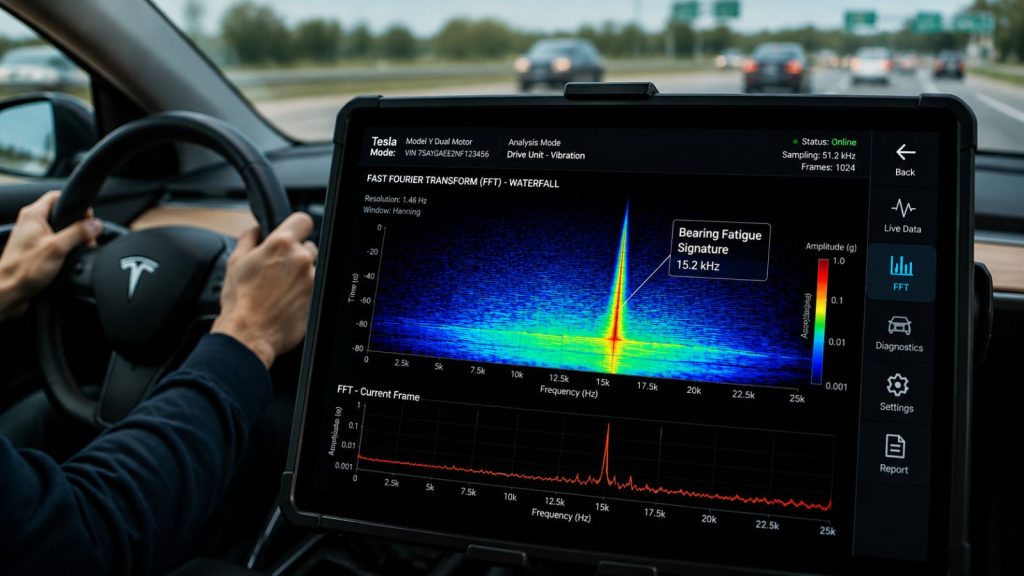
I am sitting in the passenger seat of a Model Y, my laptop connected to the data port, watching the waterfall display on my screen while we merge onto Highway 217. Most drivers hear a faint hum and assume it is just the Oregon rain against the tires or the concrete texture of the freeway. They are wrong. What I am tracking is a ghost note, a high-frequency harmonic that lives in the 14kHz to 16kHz range.
Electric drive units do not rumble like a combustion engine. When a bearing begins to fatigue, it does not growl. It sings a high-pitched, oscillating song that changes intensity every time the driver lifts off the accelerator and regenerative braking kicks in. While tire noise creates a chaotic, low-frequency thrum that spreads across the entire spectrum, a failing rotor bearing produces a precise, narrow-band frequency. I can see it on my screen. It is a sharp, clean line that stands out against the muddy background noise of the road. The sound is the result of a rolling element traveling across a raceway that has lost its microscopic surface consistency.
Is it Just Tire Roar or a Bearing Race Failure
Analyzing the telemetry from the Tigard-Portland corridor clarifies why this issue remains elusive to the average driver. Our local roads are rough, and the constant stop and go of the I-5 interchange creates thermal cycling that keeps the drive unit under perpetual load. The commute from Tigard into Portland involves constant speed changes that mask the early stages of wear. Routine diagnostic checks typically show the motor performing within normal parameters, failing to capture the underlying mechanical wear.
They miss the mechanical reality because they are looking for electrical faults, not physical degradation. I rely on acoustic mapping because it ignores the electrical signal and listens to the hardware. When the road surface changes from smooth asphalt to the grooved concrete found near the interchange, the vibration profile shifts, but the ghost note remains. That is how I know it is internal.
How Do We Measure the Invisible Mechanical Struggle
I have an ultrasonic microphone clamped to the drive unit housing, and I am watching the FFT waveforms dance across my diagnostic tablet. If I only relied on a generic OBDII scan, I would see nothing. The car thinks it is perfectly healthy because the motor is still spinning and producing torque. But the waveforms tell a different story. I am looking for the specific signature of the bearing cage.
A healthy bearing shows a flat, quiet spectrum. This unit is showing distinct peaks. I am watching the vibration sensors pick up the way the motor casing resonates as we climb the grade near Scholls Ferry Road. Every time the regenerative braking engages to slow the vehicle, the load reverses on the bearing, and the amplitude of that 15kHz signal spikes.
Detecting the 0.02mm Deviation in Bearing Tolerance
Tesla markets these drive units as sealed for life, but no mechanical system is immune to the physics of high-mileage commuting. The smoking gun is a specific amplitude spike at the bearing cage frequency. That 0.02mm deviation in race tolerance acts as an early warning, confirming that the internal components are no longer gliding but are beginning to grind. Many technicians wait for the telltale grinding sound, but by then, the damage is already permanent.
At that point, the gear oil is likely compromised by metallic debris, meaning the window for a proactive, simple repair has already closed. Metal shavings will have already started circulating through the reduction gear oil. Catching that 0.02mm deviation now allows us to perform a proactive repair before the drive unit becomes a total loss.
Proactive Maintenance for Tigard Tesla Owners
If you suspect your Tesla is singing a song it should not be, reach out to Tigard SUV and Auto at 12394 SW Scholls Ferry Rd, Tigard, OR. If you are hearing this 14kHz–16kHz harmonic on your commute, bring the vehicle in. I can put it on the lift, run the FFT analysis, and tell you exactly how much life is left on your bearings before the gear oil becomes contaminated.
Frequently Asked Questions
Can a standard Tesla diagnostic scan detect early bearing wear?
No. A standard diagnostic scan usually fails to detect early bearing wear. Tesla’s built-in diagnostic systems primarily monitor electrical and software parameters. Early bearing wear causes subtle acoustic shifts only detectable through precision vibration analysis.
Is the high-pitched whine during regenerative braking a sign of bearing fatigue?
Yes. This is often a symptom of mechanical resonance or bearing fatigue. When the drive unit transitions from acceleration to regenerative load, the physical forces inside the motor shift. If a bearing is worn, this load reversal can amplify existing vibrations, creating a high-pitched, oscillating acoustic signature.
Does tire noise differ significantly from drive unit vibration?
Yes. Tire noise is a low-frequency, broad-spectrum sound that changes primarily with road surface texture and speed. In contrast, drive unit vibration caused by bearing fatigue is a precise, high-frequency harmonic. This ghost note modulates in intensity based on motor torque loads and regenerative braking cycles, rather than road surface conditions.
Do electric drive units experience mechanical wear over time?
Yes. All mechanical drive units experience wear, even those marketed as “sealed for life.” While electric motors are more durable than combustion engines, the internal bearings and races are subject to constant physical stress. Over time, particularly in high-mileage vehicles, these components can develop microscopic tolerances that eventually lead to failure.
Can acoustic analysis help prevent a total drive unit loss?
Yes. Predictive acoustic maintenance allows for early detection of bearing cage failure. By identifying specific amplitude spikes in the 14kHz to 16kHz range before they manifest as grinding or heat damage, technicians can perform targeted repairs, preventing the need for a full, costly drive unit replacement.